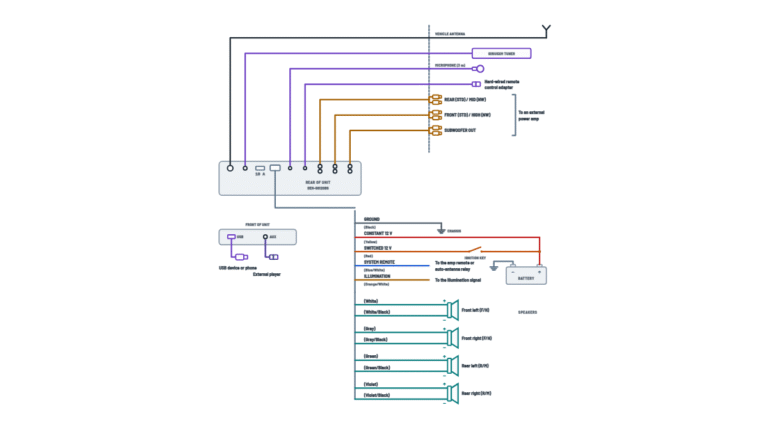
Power Acoustik Gothic 12 in GW-124 Subwoofer Wiring Diagram

Wiring options
One to four dual 4 Ω voice coil subwoofers and the load the amplifier sees in each case.
Terminals and components · 4
- Positive
- Negative
- Voice coil jumpers
- Subwoofer
Load by wiring
Load Subwoofers Voice coils 2 Ω 1 Parallel 8 Ω 1 Series 1 Ω 2 Parallel 4 Ω 2 Series 2.67 Ω 3 Series 2 Ω 4 Series Both voice coils
Both voice coils must be connected to the amplifier: never leave one disconnected.
Check the load
Before wiring, measure each voice coil with a multimeter: a 4 Ω coil reads about 3.8 Ω. If it reads close to 2 Ω, every load on this page is half.
Parallel
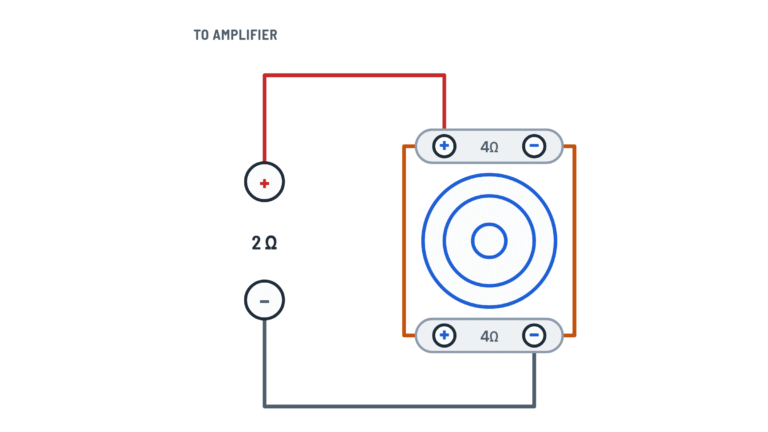
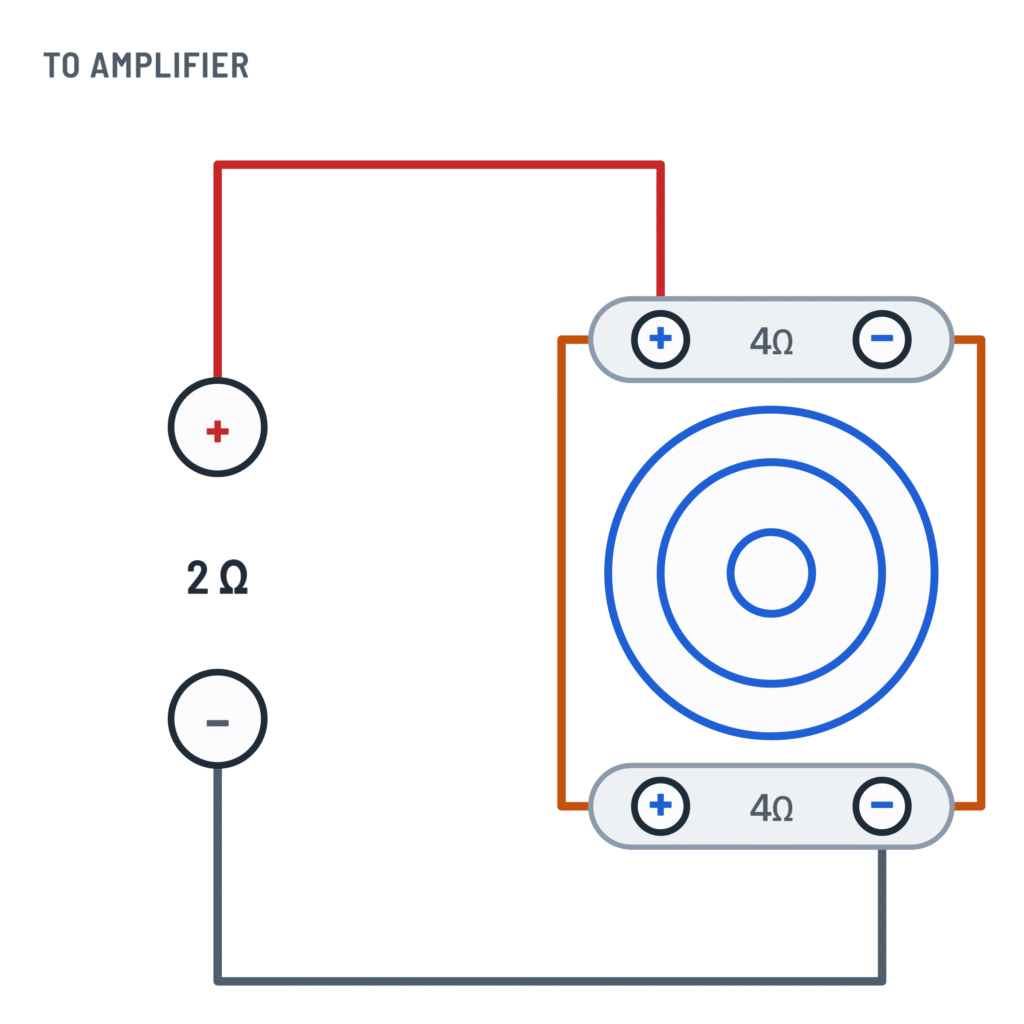
Join the + of one voice coil to the + of the other, and − to −: each subwoofer becomes 2 Ω.
Series
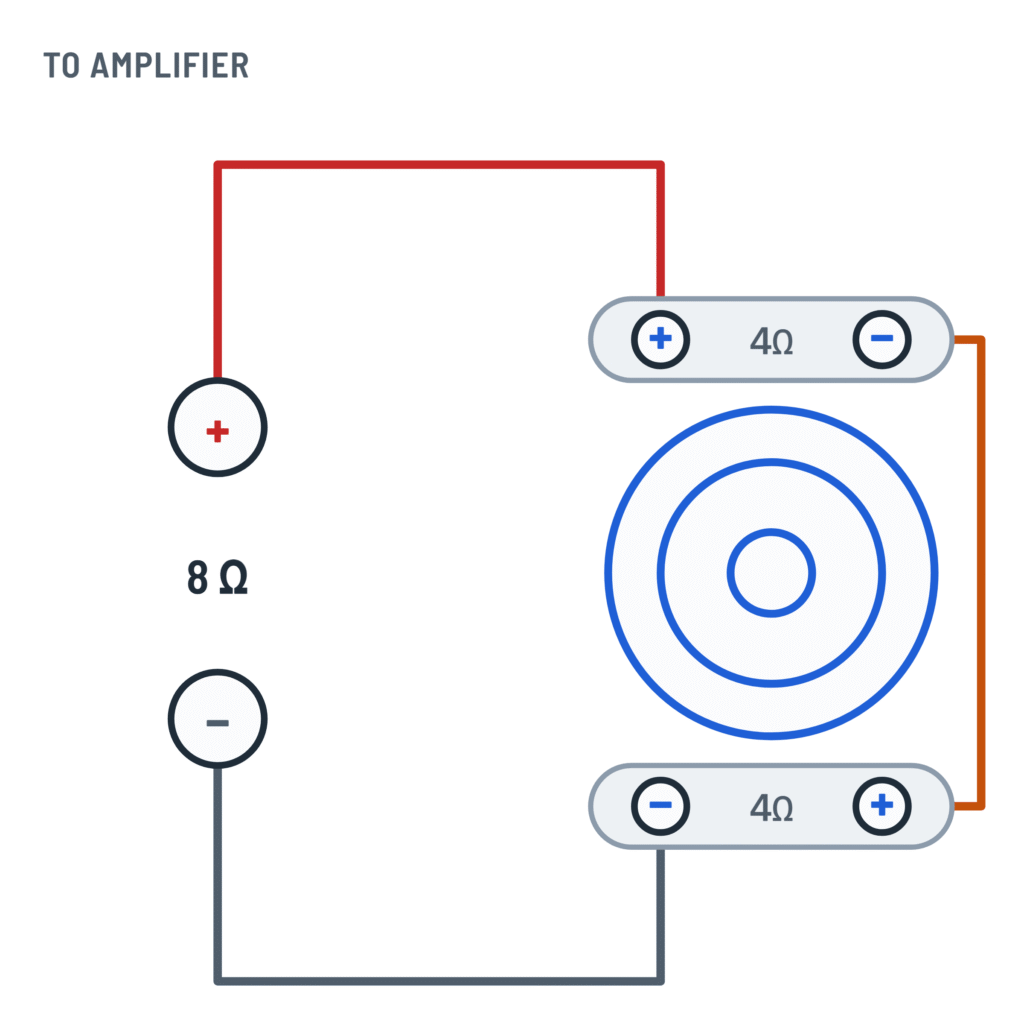
Join the − of the upper voice coil to the + of the lower one: each subwoofer becomes 8 Ω.
About This Diagram
This diagram is redrawn from page 4 of the Power Acoustik Gothic 12 in GW-124 Subwoofer manual, and we offer it completely free and in English. We have also categorized it in the Car Audio & Stereo (Automotive) section on Diagramverse, and it has been rated by 1 user with an average rating of 5.0. If you have any specific questions about the Power Acoustik Gothic 12 in GW-124 Subwoofer Wiring Diagram, we suggest checking the Frequently Asked Questions (FAQs) section.
Printable Gothic 12 in GW-124 Wiring Diagrams


Wiring Instructions
Before you start
The Gothic 12 in GW-124 subwoofer with two 4 Ω voice coils. Each coil has its own + and − terminal pair. It is rated at 1200 W RMS and 2500 W maximum. Your job is to join the two coils into one final load, then connect that load to an amplifier that is stable at that impedance. Start by choosing a variant in the diagram selector:
- 1 sub · 2 Ω: one subwoofer, coils in parallel. Use a monoblock amplifier stable at 2 Ω.
- 1 sub · 8 Ω: one subwoofer, coils in series. Use this for amplifiers that need a high load.
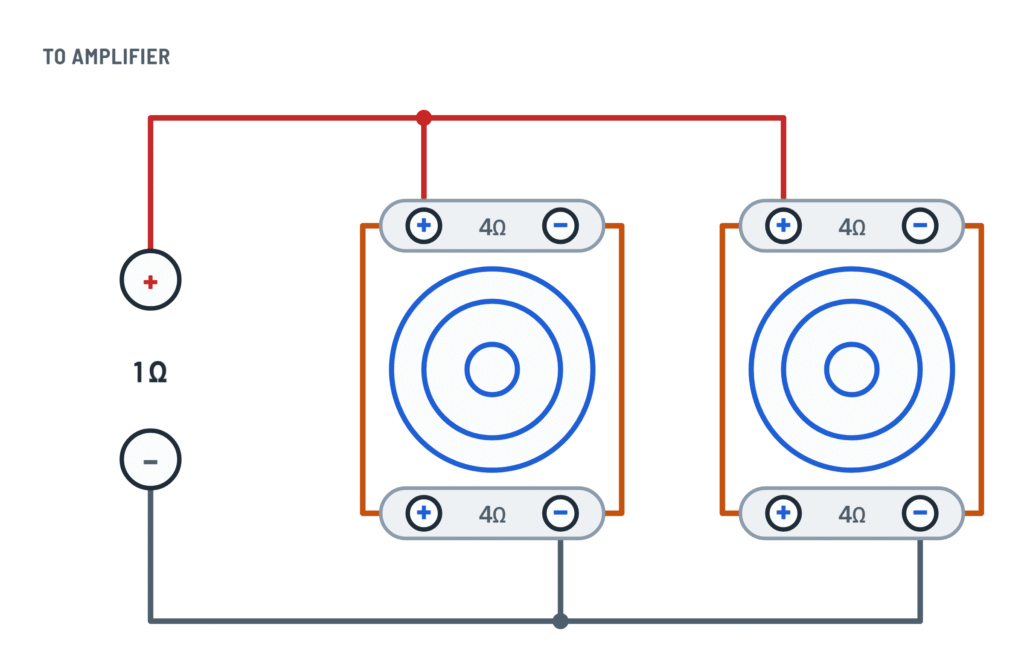
- 2 subs · 1 Ω: each sub's coils in parallel, then the two subs in parallel. Use only a monoblock rated for 1 Ω.
- 2 subs · 4 Ω: each sub's coils in series, then the two subs in parallel. This suits a monoblock at 4 Ω or a bridged 2-channel amplifier.
- 3 subs · 2.67 Ω and 4 subs · 2 Ω: each sub's coils in series, then all subs in parallel. Use a monoblock stable at or below the final value.
Check the amplifier's spec sheet or rating label for its minimum stable impedance and its RMS output at that impedance. Ideally the output should not exceed 1200 W RMS per subwoofer.
Tools and materials: wire strippers, a crimper, a screwdriver, a digital multimeter, short jumper wire, and speaker wire long enough to reach the amplifier. The sources do not give a speaker wire gauge. As a general rule, use heavy-gauge stranded copper for a sub this powerful, and keep runs short. The nickel-plated terminals are made for 8 ga wire, so do not go thicker than that. Use the same gauge for the voice coil jumpers as for the main run.
Enclosure: mount the sub in its box before you wire it. A sealed box should be at least 1.25 cu ft, with 1.50 cu ft as the optimum. A ported box should be at least 2.00 cu ft, with 2.50 cu ft as the optimum. The cutout is 11" and the mounting depth is 6.25".
Isolate power: turn the audio system off and disconnect the vehicle battery's negative cable before you handle any wiring. No permit is needed for car audio. If you aren't comfortable running the amplifier's power cable and fuse, have an authorized dealer or a qualified installer do the job.
Step-by-step wiring
- Identify the two voice coils on the terminal panel. In the diagram, the upper pair is voice coil 1 and the lower pair is voice coil 2. Note which terminal of each pair is + and which is −.
- Strip about 1/2" of insulation from each wire end and twist the strands tight. Crimp on terminals if your connectors call for them.
- Fit the Voice coil jumpers to match your variant. For a parallel sub (1 sub · 2 Ω, 2 subs · 1 Ω), join coil 1 + to coil 2 + and coil 1 − to coil 2 −. For a series sub (1 sub · 8 Ω, 2 subs · 4 Ω, 3 subs · 2.67 Ω, 4 subs · 2 Ω), join coil 1 − to coil 2 + only.
- Repeat step 3 on every subwoofer in the system. Every sub must be wired the same way.
- Run a wire from Amplifier positive to the + terminal of voice coil 1 on each subwoofer.
- Run a wire from Amplifier negative to the − terminal of voice coil 2 on each subwoofer.
- Tighten every terminal firmly. Tug each wire to confirm it is secure, and check that no stray strands touch a neighboring terminal or the metal frame.
- Before you reconnect power, measure the load. Set the meter to ohms and read across the two speaker wires at the amplifier end with the amplifier disconnected. A DC reading normally comes out a little below the nominal value. Use it to confirm you have roughly 1, 2, 2.67, 4 or 8 Ω as intended. If the reading is near 0 Ω, look for a short. If you see an open circuit, look for a loose connection.
- Connect the speaker wires to the amplifier's speaker output. Keep + to + and − to −.
Testing and start-up
Reconnect the battery. Set the amplifier gain to minimum and the bass boost off, then turn on the system at low volume. Play bass-heavy music you know well. You should hear clean, tight bass from every sub with no rattling or distortion. If you have more than one sub, put a hand on each cone. They should all move together.
Set the amplifier's low-pass crossover for subwoofer duty. Then raise the gain slowly until the bass is full but not distorted. Watch the amplifier for a protect light or excessive heat during the first half hour. If it goes into protect, turn the system off and recheck the load before you go any further.
Safety notes
- Always connect both voice coils. Never leave a coil unconnected or drive just one coil.
- Never run an amplifier into a load below its rated minimum impedance. It can overheat, shut down or fail.
- The amplifier's power cable must be fused close to the battery. Use the fuse size the amplifier maker specifies.
- High-power amplifiers produce enough voltage at the speaker terminals to give you a shock. Don't touch bare speaker connections while the system is playing.
- Secure the enclosure in the vehicle so it can't move during braking or a collision. A 16 lb driver in a loose box is a hazard.
- Long exposure to high bass levels can damage your hearing. Keep the volume at a level you can listen to safely.
Troubleshooting
| Symptom | Probable Cause | What to Check |
|---|---|---|
| The amplifier goes into protect mode as soon as I turn it up | The final load is below what the amplifier can handle, for example 1 Ω on an amplifier rated for 2 Ω minimum. Another possibility is a shorted wire. | Disconnect the speaker wires and measure them with an ohmmeter. Compare the reading with the variant you chose and the amplifier's minimum impedance. If it reads near 0 Ω, look for stray strands bridging the terminals or touching the frame. |
| Weak, thin bass even at high volume | Two subs are out of phase, or one sub's coils are reversed against each other. | Check that each sub runs from coil 1 + to the amplifier + and from coil 2 − to the amplifier −. If any series jumper goes − to −, change it to coil 1 − to coil 2 +. |
| The sub plays very quietly and the amplifier seems underpowered | A single sub is wired in series at 8 Ω on an amplifier that makes most of its power at low impedance. | Measure the load. If your amplifier is stable at 2 Ω, rewire to the 1 sub · 2 Ω variant with + to + and − to − jumpers. |
| No sound at all from the subwoofer | An open circuit from a missing jumper or a loose wire. A blown amplifier fuse is also possible. | Measure across the speaker wires with the amplifier disconnected. An open reading means a jumper or terminal isn't making contact. Also check the amplifier's power fuse and its remote turn-on lead. |
| Only one of my two subs is playing | One sub's wires didn't get connected to the amplifier, or that sub's jumper is missing. | Measure each sub on its own at its terminals. It should read about 2 Ω for a parallel sub or about 8 Ω for a series sub. Retighten the connections to the amplifier. |
| The amplifier gets very hot and shuts down after a while | The load is too low for the amplifier, the speaker wire is too thin, or the bass boost and gain are set too high. | Confirm the measured load is within the amplifier's rating. Use heavier speaker wire. Lower the gain and turn bass boost off. |
| Crackling or bass that cuts in and out | A loose terminal or a frayed wire touching metal. | With the system off, retighten all eight terminals on each sub and the amplifier outputs. Inspect the wire where it passes through the enclosure, and seal or replace any damaged sections. |
| Distorted, flapping sound and the cone seems to move too far | Too much power, a box that's too small, or no low-pass filter. | Keep the amplifier's RMS output at or below 1200 W per sub. Check that the box is at least 1.25 cu ft sealed or 2.00 cu ft ported. Set the low-pass crossover. |
| A burning smell, or the sub stopped working after hard use | Only one coil was connected, which overloads that coil. Or the sub was overdriven. | Measure each coil on its own with the jumpers removed. Each should read a few ohms. An open or shorted coil means the driver is damaged. Rewire with both coils connected. |